Video Ad Creative Testing: The Complete Guide
Updated 2026-10-07

Video Ad Creative Testing: The Complete Guide
Without a defined goal, video ad creative testing can produce a favorite ad without producing a useful business decision. It is the structured comparison of video ad concepts or elements to learn which better supports a defined advertising goal. For marketers, creative teams, and growth leads, the aim is to identify what deserves further investment under specific conditions.
A useful test starts with a decision, not a pile of assets. Even the choice between still images and video needs context: the guide to product videos versus photos explains how to assess that format question without assuming video always wins.
What is video ad creative testing?
Creative testing focuses on what an ad communicates and how it communicates it: the buyer problem, message, opening, demonstration, evidence, or call to action. Broader campaign optimization also includes audience selection, bidding, placements, budget allocation, and landing pages.
Those areas interact, but changing them together makes the creative's contribution harder to identify. If an ad receives a new opening and a different audience, improved performance cannot confidently be assigned to the opening alone.
Results depend on the audience, offer, placement, delivery conditions, and measurement method. A concept that attracts qualified buyers in a demo campaign may behave differently when shown to an unfamiliar audience with an educational offer.
The intended learning also matters. Comparing complete concepts can reveal a promising message direction. Comparing closely matched executions can help isolate a particular element. Neither approach produces a permanent winner independent of context.
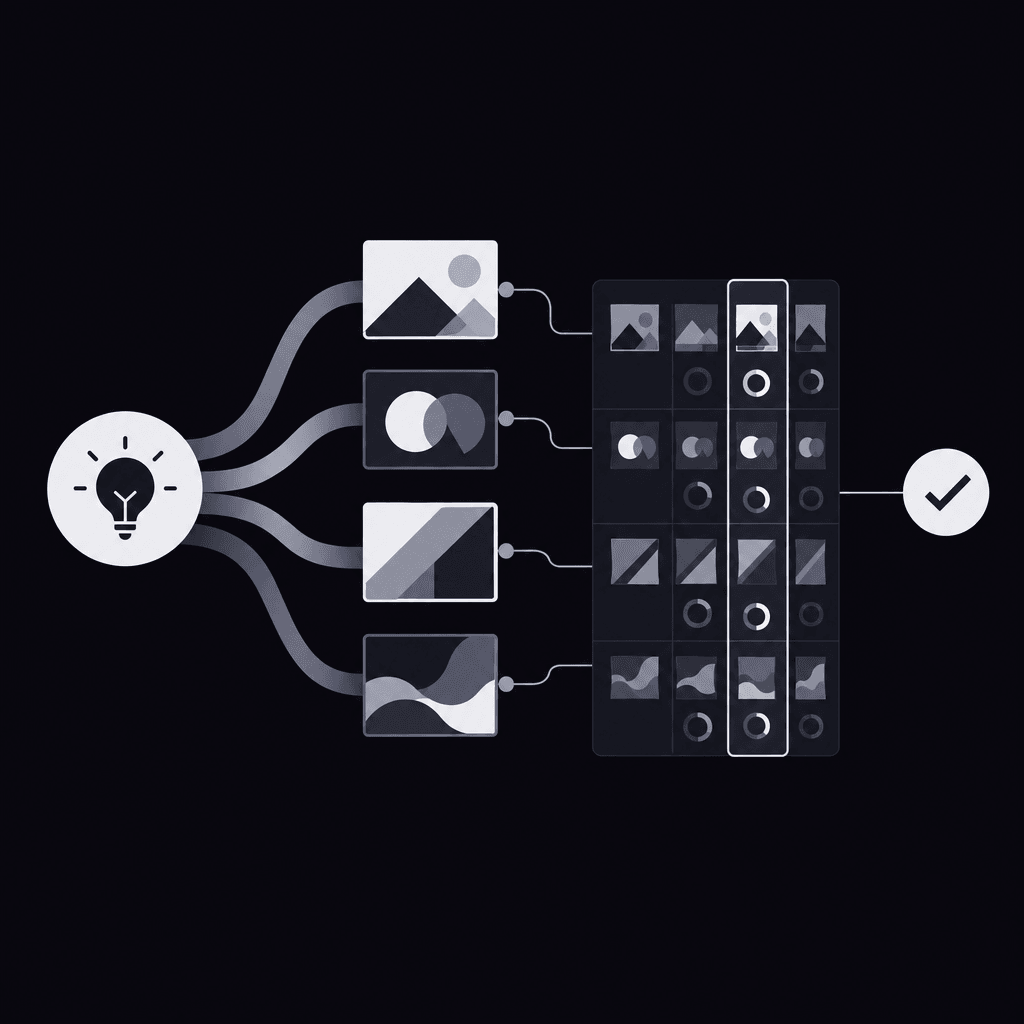
15-second video ad script examples: a starting point for testing
A short script gives a test structure: an opening that earns attention, a recognizable buyer problem, a product demonstration, and a clear next action. Those elements don't require a universal timing formula. Their emphasis should follow the question being tested.
Consider a hypothetical project-management SaaS campaign, not a customer result. A problem-led opening could say, "Project updates are scattered across chat threads." An outcome-led alternative could say, "See project status in a shared view." Both would then show the same approved status dashboard and end with the same demo invitation.
Keeping the demonstration and CTA consistent makes the opening the intended difference. Changing the entire script would instead compare broader concepts.
The planned guide, 15 second video ad script examples, will expand on script structures and variations. Until it is published, this paired-opening example offers a starting point without implying that either version will perform better.

How to fix video ad creative fatigue
Fatigue is a possible explanation for declining response, not a diagnosis based on a falling click-through rate. Rising exposure alongside weakening performance should trigger investigation.
Audience saturation, delivery changes, tracking problems, a slower landing page, and a changed offer can create similar symptoms. Reviewing those conditions first prevents unnecessary production work. For video ad creative testing, suspected fatigue becomes a question to investigate rather than an automatic instruction to replace an ad.
If the evidence points toward a creative problem, a new buyer angle or opening can test a meaningful alternative. Replacing a background color may change appearance without changing the reason to care.
The planned guide, How to fix video ad creative fatigue, will provide detailed troubleshooting. Its role will be to separate likely causes and guide refresh decisions, rather than prescribe a replacement schedule that ignores campaign conditions.
What should you test in a video ad?
Concepts and messages
A concept combines a buyer problem, promise, and way of explaining the product. In a hypothetical SaaS campaign, a manual-workflow concept might focus on repeated status reporting, while a visibility concept emphasizes uncertainty about project progress.
That comparison can inform positioning. It cannot establish which individual line or visual caused the difference. For teams developing this material, the SaaS explainer use case provides a relevant production context; the experiment still needs its own design.
Hooks and opening visuals
Once a message has support, video ad hook testing can compare narrower choices: a problem statement versus an outcome statement, or a product screen versus a workflow illustration. Keeping the body and CTA unchanged supports a more specific learning claim, provided delivery conditions are also comparable.
Product demonstrations and proof
A demonstration should make the proposed benefit understandable using accurate product behavior. Teams might compare a workflow overview with a focused view of the relevant feature. Any claim needs support, and generated stories should never stand in for verified customer testimony.
CTAs and presentation
CTA language, text legibility, pacing, and framing can affect response. Changing the offer itself, however, creates a broader test: a demo request and an educational download ask for different commitments. The conclusion should reflect that distinction rather than treating all CTA changes as equivalent.
Choose metrics that match the business goal
In video ad creative testing, the primary metric should reflect the decision the business needs to make. Viewing and click metrics help explain response, but neither establishes business value by itself.
- Awareness: Reach and video consumption can describe exposure and attention. They don't, on their own, prove recall or incremental demand.
- Traffic: Click-through rate and landing-page arrivals can reveal whether an ad attracts visits. Click-through rate should state which clicks are counted and use ad impressions as its denominator.
- Conversion: Desired actions, conversion rate, and cost per desired outcome connect response to a business objective. The desired action must be named explicitly.
For B2B SaaS video ads, demo requests are different from qualified demos, opportunities, and revenue. A campaign that generates inexpensive requests from unsuitable companies may be less useful than one producing fewer, better-fit conversations. Downstream outcomes belong in the assessment when they can be reliably tracked.
Definitions should travel with reports. Cost per qualified demo is spend divided by qualified demos. A landing-page conversion rate might be demo requests divided by measured landing-page sessions. Qualification rate could be qualified requests divided by reviewed requests, with pending reviews identified separately.
Video-view definitions also vary. Hook rate may describe the share watching past the first three seconds, but reports should identify the denominator and platform definition. Completion rate needs its own definition of starts and completions.
The same discipline applies to purchases: the online store product videos use case changes the desired outcome, not the need to distinguish attention from conversion.
Build a hypothesis and video ad creative testing matrix
A hypothesis connects a creative change to a buyer-level explanation. "Try a different opening" names an activity. A useful hypothesis identifies the audience, change, expected outcome, and reason.
A useful test should change the next production decision, even when the result is inconclusive.
The reusable template is: "For [audience], changing [creative element] from [control] to [variant] may improve [primary outcome] because [reason]."
For example: "For operations managers evaluating project software, changing the opening from manual reporting pain to project visibility may improve qualified demo requests because cross-team uncertainty may be the more urgent problem." This is a hypothetical proposition, not a performance claim.
An ad creative testing matrix makes competing questions easier to prioritize. The following example compares a broad concept decision with a narrower execution decision; neither row contains assumed results.
| Buyer problem | Concept | Changed variable | Control | Primary metric | Guardrail metric | Decision criterion |
|---|---|---|---|---|---|---|
| Unclear project progress | Shared visibility | Complete message concept | Manual-reporting concept | Cost per qualified demo | Opportunity progression rate | Advance if the meaningful improvement specified before launch is supported without unacceptable quality loss |
| Scattered status updates | Clearer project status | Opening statement | Problem-led opening | Cost per qualified demo | Request qualification rate | Keep the new opening if evidence meets the predeclared criterion; otherwise revise or retest |
Priority should follow decision value and feasibility. If positioning remains uncertain, polishing CTA wording may answer a less important question than comparing buyer problems.
Design a test that can answer your question
A comparison becomes difficult to interpret when the variants also differ in audience, offer, placement, landing page, bidding, budget allocation, or timing. These factors should be held comparable where practical and documented wherever they differ.
Randomized split testing assigns eligible exposure through a defined random process. Ordinary algorithmic delivery may instead favor an ad based on predicted response and other delivery signals. Unequal delivery in that setting isn't equivalent to a controlled experiment.
For video ad creative testing, the method determines the strength of the conclusion. An observational comparison may identify a candidate for further investigation, while a well-designed randomized comparison can better support a causal claim within its tested conditions.
Before launch, the test plan should record the primary outcome, acceptable quality guardrails, a meaningful difference, and stopping rules. It should also specify what happens if delivery is uneven, measurement fails, or outcomes arrive too slowly.
Feasibility depends on the creative testing budget, expected outcome frequency, baseline variation, and the size of the improvement worth detecting. Rare qualified demos make small differences difficult to distinguish from ordinary fluctuation. No universal spend or duration resolves that problem.
If the available budget cannot support the intended conclusion, the team can reduce competing variants or choose a more focused question. The limits should remain visible rather than disappearing behind an engagement metric.
Check measurement before interpreting performance
A sound creative comparison can still fail at measurement. Before launch, the team should complete a practical validation pass:
- Destination URLs: Confirm that every ad reaches the intended page and that campaign parameters survive the journey.
- Campaign labels: Give each concept and variation a consistent identifier that connects the report to the actual asset.
- Conversion events: Check that the intended action fires correctly and isn't duplicated during an ordinary completion path.
- CRM handoffs: Where applicable, confirm that lead records preserve useful source information and receive consistent qualification treatment.
- Attribution settings: Record the attribution window and rules used to assign credit.
- Reporting consistency: Align date ranges, time zones, event definitions, and metric denominators before comparing results.
A recorded demo request is an observed event. Assigning that request to an ad is an attribution decision. Claiming the ad caused an additional request requires stronger evidence than either observation or attribution alone.
Longer B2B sales cycles also delay the picture. Recent leads may still be awaiting qualification while older leads have reached opportunities. Comparisons should account for that difference in maturity.
No tracking setup captures every conversion. The practical objective is sufficiently consistent measurement for the decision, with gaps acknowledged. Reviewing buyer fit alongside acquisition cost helps expose creative that attracts cheap clicks but unsuitable prospects.
Decide whether to keep, revise, or retest a creative
For video ad creative testing, the decision should combine the primary outcome, quality guardrails, uncertainty, delivery conditions, and downstream results. A dashboard ranking is only an input.
- Promising result: The primary outcome improves meaningfully, guardrails remain acceptable, and the comparison is credible. The concept can move into further production and validation.
- Weaker result: The variant underperforms under a trustworthy comparison. Revision should address the hypothesis or execution, rather than produce an arbitrary cosmetic change.
- Inconclusive result: Outcome volume is limited, variation is wide, or delivery is imbalanced. The record should preserve that uncertainty instead of naming a winner.
- Conflicting signals: Click-through improves while qualified demos decline. The opening may be attracting curiosity, setting inaccurate expectations, or appealing to the wrong buyers.
Repeatedly checking results and stopping as soon as a favorable pattern appears can mistake random movement for improvement. Predeclared stopping rules help keep the decision from following the most flattering moment.
Meaningful findings deserve retesting under relevant conditions. Higher spend or a broader audience may change the outcome. Context matters outside SaaS, too: with property listing videos, a different property or buyer pool can change response independently of creative quality.
The learning record should state what happened, where it happened, and how confidently the team can act on it.
How to choose your first test and get started
The first test should address the most important uncertainty that production can change. Uncertain positioning favors concept testing; an established message with a weak opening favors a narrower element comparison.
- Define the business outcome. A hypothetical SaaS demo campaign might prioritize qualified demo requests rather than total form submissions.
- Identify the current bottleneck. Existing reporting may suggest weak initial response, poor post-click conversion, or unsuitable leads. Each points toward a different question.
- Choose a creative question. For uncertain positioning, compare manual-reporting pain with project-visibility pain.
- Select the control. Use the existing relevant creative or a documented baseline execution, not whichever asset happens to be available.
- Prepare variants. Specify which elements may change and which must remain comparable.
- Validate measurement. Confirm the journey from ad interaction through the chosen qualification outcome.
- Document decision rules. Record guardrails, stopping conditions, and the treatment of inconclusive results.
- Launch and inspect delivery. Check for implementation problems without repeatedly rewriting the experiment around early fluctuations.
For placement-specific production planning, the short-form social ads use case is relevant once the creative question is clear. Production volume should follow the test plan rather than determine it.
When qualified outcomes are too scarce, narrowing the question and reducing competing variants may help. Directional signals can guide the next draft, but they remain provisional; engagement shouldn't quietly replace sales success as the goal.
Create the next variants and maintain a learning library
A learning library turns separate campaigns into accumulated knowledge. Each entry should contain the hypothesis, asset versions, audience and delivery conditions, metric definitions, results, uncertainty, decision, and next question.
For video ad creative testing, a useful record explains why production should change. "Visibility-led concept merits another comparison with the same buyer segment" is more actionable than "Variant B won." The record should also preserve rejected ideas and measurement failures so teams don't unknowingly repeat them.
Production tools belong downstream of that learning. Vidrava AI's video generation follows the proposition "one idea, one finished video," with a workflow described as "brief, plan, generate, export." It can be considered as a production example without treating it as an experiment manager or performance measurement system.
Its listed sixty-second SaaS explainer template is a separate production reference, not a requirement that short-form test ads use that length. The chosen format should fit the message and placement.
Where approved screenshots, photos, and graphics form the source material, the guide to making videos without filming expands on preparation and storyboarding. Asset reviews should still check product accuracy, claim support, and consistency with the intended experiment.
A repeatable review process closes the loop: retain the learning, state the next uncertainty, and commission only the variants needed to address it.
FAQ
What should a team test first in video ad creative testing?
The most consequential unresolved creative question should come first. If positioning is uncertain, concept testing can compare distinct buyer problems or messages. If an established concept needs refinement, an opening or demonstration comparison supports a narrower conclusion. The hypothesis and matrix section provides a reusable starting structure.
How many variants can a small audience support?
That depends on available exposure, outcome frequency, and the difference the team needs to detect. Additional variants divide the available evidence. A small audience may support a focused comparison better than a broad set of alternatives, but repeated exposure and limited qualified outcomes can still leave the result inconclusive.
How long should a test run, and what budget does it require?
Duration and budget depend on delivery, baseline variation, conversion delay, and the frequency of the primary outcome. Both should be considered before launch, alongside stopping rules. A test shouldn't end simply because an early result looks favorable, nor continue indefinitely without a realistic path to answering its question.
What if clicks improve but qualified demos decline?
The business outcome takes priority over the easier engagement win. Qualification consistency, landing-page expectations, audience delivery, and lead maturity all deserve review. If those checks hold, the creative may be attracting the wrong interest. A revised message can communicate buyer fit more clearly, even if that reduces total clicks.
When should a video ad be refreshed?
A refresh is warranted when evidence suggests the creative needs changing, not when a calendar interval expires. Increasing exposure and weakening response can justify investigation, but tracking, delivery, audience conditions, and the offer should be checked first. A meaningful new angle may be more useful than a cosmetic edit.
For the next step in video ad creative testing, start with How to Make Product Videos Without Filming; return for 15 second video ad script examples and How to fix video ad creative fatigue when published.