Ecommerce Video Marketing: The Complete Guide
Updated 2026-10-07
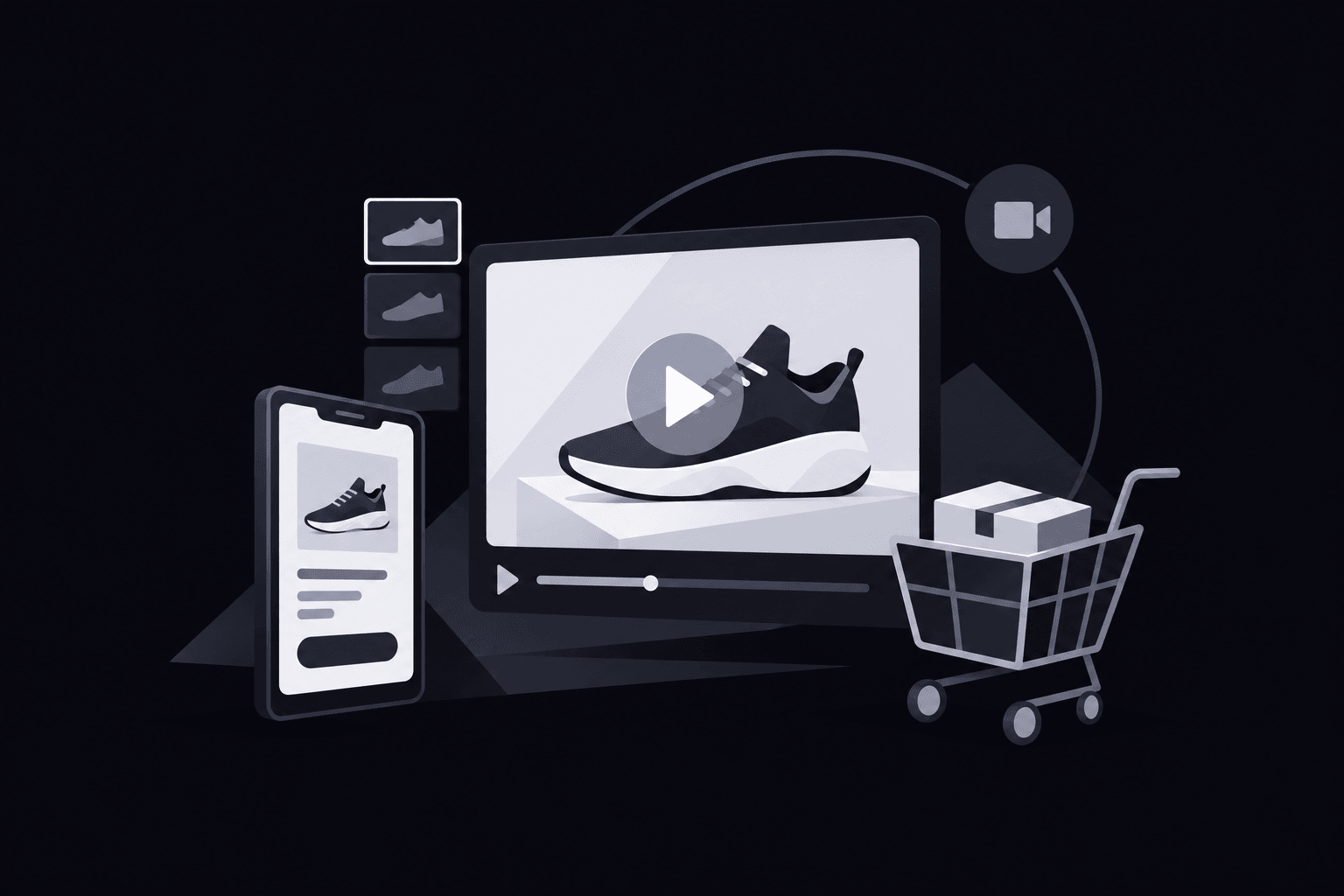
Ecommerce Video Marketing: The Complete Guide
What is ecommerce video marketing? It is the use of video to help online shoppers understand products, evaluate an offer, and decide whether to buy. For store owners and marketing teams, it connects product storytelling with business outcomes across product pages, social feeds, advertising, and email.
The starting point is a shopper's unanswered question, not a production technique. A demonstration can clarify how a product works; a close-up may explain its construction. Tools such as Vidrava AI's video generator offer another production route, but the message still needs accurate product information and a clear purpose.
What is ecommerce video marketing?
Video marketing for online stores includes paid creative, product demonstrations, educational clips, and content that supports existing customers. Its role changes with the placement: a social ad may introduce a problem, while a product-page demonstration helps someone assess suitability.
The useful distinction is between attracting attention and resolving uncertainty. A memorable opening can earn a view without explaining whether the product fits the shopper's needs.
Vidrava AI's overview of AI product videos for stores provides a product-focused starting point. Regardless of the production method, each asset should have an intended audience, a supported message, and an observable next action.

How to Make Product Videos Without Filming
A new camera shoot isn't required for every product story. Existing photography, approved product information, diagrams, and licensed creative assets can provide the foundation for a video. Depending on the production method, those materials might become an animated sequence, an edited presentation, or AI-assisted creative.
The key is distinguishing illustration from demonstration. Motion applied to a product photo can highlight a feature, but it doesn't prove how the product behaves in real use. A generated scene shouldn't serve as evidence of durability, fit, capacity, or performance.
A practical starting point is an asset audit. The team checks whether available images show the correct variant, whether specifications are current, and whether every asset has permission for the intended use. Missing proof should change the creative concept rather than invite a fabricated demonstration.
The planned guide, How to Make Product Videos Without Filming, will expand on asset selection, production choices, and quality checks. Until it is published, the central rule is simple: use creative motion to explain verified information, not to manufacture evidence.

Product Video vs. Product Photos: How to Compare Conversion Rates
There isn't a universal conversion winner between video and photography. The result depends on the product, the shopper's uncertainty, the creative execution, and the buying experience around it.
Photos can make details easy to inspect without waiting through a sequence. Video can explain movement, setup, or a relationship between features. Many stores need both: photography for quick comparison and video for questions that require an unfolding explanation.
For ecommerce video marketing, the useful comparison is a specific treatment against a defined baseline. Adding a demonstration to a product page tests the incremental value of that demonstration. Replacing an image ad with a video ad tests a different creative package. Those experiments answer different questions.
The planned Product Video vs. Product Photos: How to Compare Conversion Rates guide will examine test design and interpretation in greater depth. Meanwhile, teams should avoid comparing unrelated campaigns or treating a before-and-after sales change as proof that video caused the difference.
Set ecommerce video marketing goals around shopper questions and buying stages
An ecommerce video strategy becomes easier to prioritize when every proposed asset is tied to a buying obstacle. Customer support conversations, product reviews, search terms, and sales feedback can reveal the language shoppers use and the details they can't find.
Different stages call for different answers:
- Discovery: Show the situation the product addresses so an unfamiliar shopper can recognize its relevance.
- Evaluation: Explain size, compatibility, materials, setup, or another detail that affects suitability.
- Purchase: Clarify the actual offer, included items, and next action without adding unsupported urgency.
- Post-purchase: Help customers assemble, maintain, or use the item correctly.
These goals shouldn't share an automatic definition of success. An instructional video might be judged by successful task completion or changes in related support requests. A paid acquisition asset needs evaluation against purchases and acquisition cost, not just viewing activity.
A useful planning statement is: "This asset helps a defined shopper resolve a specific uncertainty, so the shopper can take an appropriate next step." If that sentence remains vague, production should wait. A clearer objective is less expensive to fix than an attractive video built around the wrong question.
Understand the Main Ecommerce Video Formats
Format is a delivery choice, not the strategy itself. The same product might need a demonstration on its product page and a concise problem-led ad in a social feed.
| Format | Best-suited question | Main review requirement |
|---|---|---|
| Product demonstration | How does it work? | Show real operation accurately. |
| Product spotlight | What matters about this item? | Keep benefits connected to supported features. |
| Explainer | Why would this solve the problem? | Make the mechanism understandable. |
| Customer testimonial | What did an actual customer experience? | Verify authenticity, permission, and claims. |
| Shoppable content | Where can the featured item be purchased? | Check product mapping and destination accuracy. |
| Live demonstration | Can questions be answered during the presentation? | Prepare moderation and accurate product information. |
For ecommerce video marketing, the simplest useful format is often preferable to the most elaborate one. A clear demonstration can be more appropriate than a narrative that delays the essential detail.
Stores selling software or app-connected products may also need a separate explanation of the digital experience. Vidrava AI's SaaS explainer video overview provides a relevant reference for that kind of message.
Testimonials require particular care. A generated first-person story isn't verified customer testimony. Any proposed likeness, voice, or testimonial workflow needs a review of the provider's full policy and the underlying permissions before production.
Plan Where Videos Belong: Product Pages, Social, Ads, and Email
A video's destination should shape its script before production begins. Someone browsing a product page already has context; someone encountering an ad may not know the brand or the problem being addressed.
Product pages: Place the asset near the decision it supports. A setup explanation belongs where shoppers evaluate complexity. Important specifications should remain available as text or images rather than becoming accessible only through playback.
Organic social: Make the product and situation understandable without relying on the surrounding caption. Short-form product videos should still deliver a complete, useful point.
Paid ads: Align the promise with the destination page. Teams planning feed-specific creative can consult the short-form social ads overview before choosing an approach. Export requirements and platform suitability should be confirmed for the actual placement.
Email: A linked preview image can direct recipients to a page where the video plays. Playback support varies by email environment, so campaigns shouldn't depend on universal embedded playback.
Shoppable placements add another operational requirement: the featured variant, price, availability, and purchase destination must agree. A compelling video can still create a poor experience if it directs shoppers to an unavailable item or a different offer.
How to Choose Your First Product, Format, and Production Approach
A manageable pilot combines a meaningful business opportunity with reliable source material. A popular SKU isn't automatically the best candidate if its product facts are unsettled or its imagery is outdated.
Product selection for ecommerce video marketing should weigh shopper uncertainty, available evidence, commercial importance, and production effort. A product with recurring compatibility questions may offer a clearer learning opportunity than an item shoppers already understand.
- If shoppers don't understand operation, then prioritize a demonstration using authentic product behavior.
- If appearance drives the decision, then retain strong photography and test video as a complement.
- If suitable footage already exists, then consider editing it before commissioning additional production.
- If accurate images and specifications exist but filming isn't practical, then assess an asset-led or AI-assisted approach.
- If the intended claim lacks evidence, then revise the message or obtain evidence before production.
Production choices also depend on review capacity. A complex product may require a technical approver; promotional pricing may require a merchandising check. These responsibilities should be assigned before the creative team starts.
The first project should leave behind a useful record: the question addressed, the assets used, the approval decisions, and the measured result. That record becomes more valuable than an isolated finished file.
Write a Product Video Brief: Audience, Message, Proof, and Call to Action
A brief is a shared decision document. It gives the producer enough direction to create the asset and gives the reviewer a clear basis for approval.
For an illustrative desk-organizer video, a practical brief could contain:
- Audience: Online shoppers assessing storage for a compact workspace.
- Shopper question: Whether the organizer accommodates the objects they use regularly.
- Message: Show the product's layout and explain its verified storage features.
- Proof: Approved dimensions, current product photography, and authentic footage if fit is demonstrated.
- Placement: A social ad leading to the matching product page.
- Call to action: A prompt to inspect dimensions and available options on that page.
- Restrictions: No invented capacity, altered proportions, unsupported material claims, or unapproved offers.
- Approval owner: The person responsible for product accuracy and final publication.
The source information should match the category. An organizer needs product specifications; a property narrative needs verified listing facts. Vidrava AI's property listing video overview illustrates why a different category requires different inputs rather than a recycled product brief.
Before approval, someone outside the creative process should be able to identify the intended message without guessing. If the brief contains competing benefits, the team should choose the detail most relevant to the shopper's decision.
Build a Five-Scene Product Ad: An Illustrative Storyboard
A five-scene outline can translate the brief into a sequence without turning the ad into a feature inventory. This illustrative desk-organizer concept describes creative practice, not a guarantee of any generation tool's capabilities.
- Hook: Establish a crowded work surface. Avoid exaggerated imagery that implies an unsupported transformation.
- Product introduction: Show the correct organizer and its actual appearance clearly.
- Benefit explanation: Connect a verified feature to the shopper's storage question. Any depicted fit should be authentic.
- Decision detail: Present an approved dimension, included component, or current offer that helps evaluate suitability.
- Next action: Direct interested shoppers toward the matching product page and the information needed to decide.
A storyboard makes ecommerce video marketing easier to review because each scene has an explicit job. Reviewers can catch an unsupported claim or missing decision detail before it becomes expensive to change.
The outline isn't a requirement for every placement. A product-page explanation may need more space for operation, while a simple social asset may need fewer ideas. What matters is a coherent progression from relevance to understanding to action.
Prepare Videos for Publishing: Accuracy, Permissions, Captions, and Mobile Viewing
Publishing requires more than creative approval. The final export should be checked against the current product listing, because generated imagery, editing choices, and stale source material can introduce inaccuracies.
Reviewers should compare the visible product, variant, accessories, dimensions, and claims with approved information. Any price or promotion needs a validity check. A visual representation of performance deserves the same scrutiny as a written performance claim.
Permissions also belong in the release process. Teams should confirm the right to use photography, footage, music, logos, and recognizable people in the intended channels. Provider policies need separate review; permission to use an asset doesn't automatically establish that a proposed generation workflow is allowed.
Captions should accurately reflect speech and remain legible on smaller screens. On-screen text needs enough viewing time, and essential meaning shouldn't depend only on sound. A mobile review should include interface overlays that could obscure product details or the call to action.
Finally, check the published experience rather than only the exported file. Playback behavior, loading, destination links, and nearby purchase controls can change the result. Product page videos should help shoppers evaluate an item without making the page harder to use.
Measure Results and Design a Fair Video-versus-Photo Test
The most useful ecommerce video marketing metrics connect the asset's purpose to behavior. Views and completion can diagnose attention, but they don't establish purchase impact by themselves.
A controlled testing plan should specify:
- The hypothesis: Adding a demonstration will help eligible shoppers evaluate a particular product question.
- The control: The existing product page with its photography unchanged.
- The treatment: The same page with the selected video added in a defined location.
- The assignment: Random allocation of eligible visitors where the testing setup supports it, with consistent variant exposure.
- The primary outcome: A defined business measure, such as purchases per eligible visitor.
- The safeguards: Monitoring of loading performance, purchase value, returns, and related support issues where measurable.
- The stopping rule: A preselected evaluation period and sample requirement appropriate to baseline activity and the effect the business needs to detect.
Pricing, promotions, inventory, and traffic sources should remain comparable. Ending a test as soon as results look favorable can produce a misleading conclusion. Low traffic may leave the outcome inconclusive rather than proving that both versions perform equally.
Comparing viewers with non-viewers isn't a substitute for randomized exposure: people who choose to watch may already differ in purchase intent. For advertising, keep audience, offer, destination, and delivery settings comparable where possible, then acknowledge remaining differences.
Plan Production Resources and Expand Across Your Product Catalog
The visible cost of generation or editing is only part of production. Teams also spend time collecting assets, checking facts, managing approvals, correcting outputs, publishing, and analyzing results.
Resource planning should assign ownership across those tasks. A small team may combine roles, but the product-accuracy check still needs an accountable owner. Agency or contractor arrangements should define revision responsibility and asset handover before work begins.
Vidrava AI uses prepaid credit packs and frames billing as paying for videos actually generated. It also offers an estimate of the first video for free. Teams should review current costs and terms before budgeting; restored credits are not monetary refunds, and eligibility requires checking the full policy.
Expansion works best by grouping products with similar shopper questions, not merely similar names. An approved structure may transfer across related SKUs, but specifications, appearance, and offers still require individual checks.
Template selection needs the same discipline. A neighborhood guide template belongs to a location-led story, not an ordinary SKU demonstration. Choosing by narrative purpose prevents a reusable format from becoming the wrong format.
A catalog content register should track source assets, approvals, destinations, and replacement triggers. Product changes or expired offers can make a previously accurate video unsuitable for continued use.
Get Started With a Repeatable Ecommerce Video Workflow
A repeatable workflow turns separate production requests into a process the team can review and improve. It should preserve creative judgment while making approvals and handoffs predictable.
Vidrava AI describes its workflow as brief, plan, generate, export, with eight stages in a queue. That structure offers a useful production reference; the store's own responsibilities still include verifying source information and reviewing the result.
A practical operating sequence is:
- Collect the shopper question and establish the intended business outcome.
- Confirm the product information, source assets, and permissions.
- Approve the message and scene plan before production.
- Generate, edit, or film through the selected production approach.
- Review accuracy, accessibility, and placement suitability.
- Publish with tracking and a documented evaluation plan.
- Record the result and decide whether to revise, retain, or expand.
A sustainable ecommerce video marketing process makes learning reusable. A weak result may point to an unclear message, poor placement, or an unsuitable product question rather than a failure of video as a medium.
Expansion should follow that diagnosis. Repeating an untested concept across the catalog creates more assets, but it doesn't necessarily create more useful information for shoppers.
FAQ
How much does ecommerce video marketing cost?
Cost depends on production method, asset readiness, review effort, revisions, and distribution. Teams should budget for the complete publishing process rather than only the export. For prepaid generation services, an estimate can help assess direct production expense before committing resources.
How long should a product video be?
Length should follow the question and placement. Product-led guidance commonly recommends around sixty seconds, but that is a planning suggestion, not a conversion benchmark. A simple feature may need less time; an operation explanation should remain clear rather than being shortened arbitrarily.
Can AI-generated visuals demonstrate product performance?
Generated visuals can illustrate an idea, but they don't establish real-world performance. Claims about fit, strength, results, or operation need authentic evidence. Creative review should catch altered proportions, invented accessories, and behavior the actual product hasn't demonstrated.
Should video replace product photography?
Usually the better starting point is to assess what each medium contributes. Photos support quick inspection; video can explain movement or a sequence. An addition test and a replacement test answer different questions, so the experimental design should match the actual merchandising decision.
What should a team publish first?
A focused asset answering a recurring shopper question is a practical starting point. The product should have reliable information, usable assets, and a clear approval owner. A narrowly defined purpose makes the result easier to assess and the next production decision easier to justify.
For the next step in ecommerce video marketing, teams can start with the production and comparison sections above; the planned guides How to Make Product Videos Without Filming and Product Video vs. Product Photos: How to Compare Conversion Rates will deepen those decisions when published. The most important caveat remains: an engaging video isn't proof of increased conversion, and results depend on what the team actually tested.